Why Construction Cost Estimates Matter
Money is the lifeblood of any construction project. Whether you are a developer building a multi-million-dollar commercial facility or a homeowner planning a custom residence, the financial viability of your project hinges on one critical element: the construction cost estimator process.
An accurate estimate does more than just tell you how much a building will cost; it forms the foundation of your financing, dictates your design choices, and sets the baseline for project success. Underestimate your costs, and you risk running out of capital before the roof is on. Overestimate, and you may scare away investors or abandon a viable project unnecessarily.
In today’s market, characterized by lingering supply chain constraints and a competitive labor market, relying on guesswork or outdated square-footage averages is a recipe for disaster. Precise construction estimating services are not a luxury; they are a necessity.
What a Construction Cost Estimator Should Include
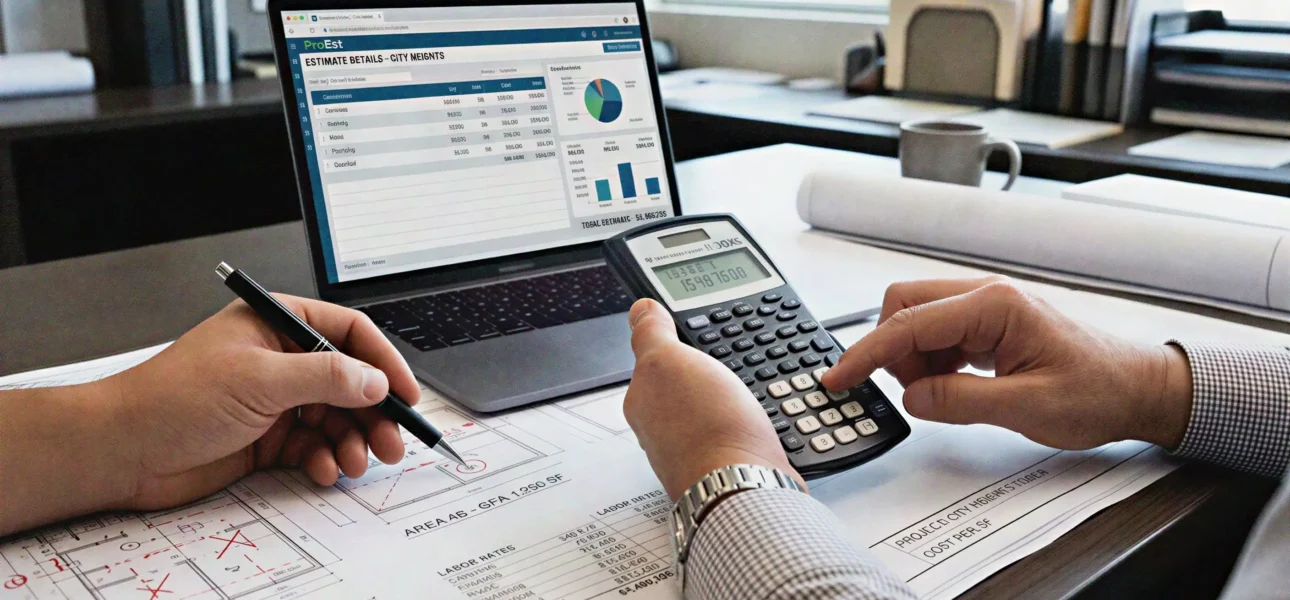
A professional construction estimate is a comprehensive, meticulously detailed document. It goes far beyond the simplistic output of a home building cost calculator. A true estimate breaks the project down into two main categories:
1. Hard Costs (Construction Costs) These are the tangible costs directly associated with building the structure. They typically make up 70% to 80% of the total budget and include:
- Materials: Concrete, steel, lumber, roofing, MEP (Mechanical, Electrical, Plumbing) systems, and finish materials.
- Labor: The wages paid to subcontractors and their crews.
- Equipment: Costs for renting cranes, excavators, and other heavy machinery.
2. Soft Costs (Non-Construction Costs) These are the ancillary costs required to get the project designed, permitted, and financed. They usually account for 20% to 30% of the budget and include:
- Design Fees: Architectural and engineering services.
- Permitting and Impact Fees: Costs paid to local municipalities for the right to build and the strain on local infrastructure.
- Insurance and Bonding: Builder’s risk insurance, liability insurance, and performance bonds.
- Financing Costs: Loan interest and origination fees.
3. Contingency and Escalation No estimate is perfect. A professional estimator will include a contingency fund (typically 5% to 10% for well-defined projects, higher for early concepts) to cover unforeseen conditions or design changes. Additionally, if the project spans multiple years, an escalation factor is applied to account for inflation and material price increases over time.
Common Estimating Mistakes
Understanding where estimates fail can help you avoid the same traps. The most common mistakes include:
- Under-Estimating Site Work: The building is easy to visualize; the earthwork is not. Soil remediation, rock removal, and unexpected underground utilities can devastate a budget if not properly investigated during pre-construction.
- Ignoring Long-Lead Items: Assuming materials will arrive on time without factoring in supply chain realities. If custom windows take 20 weeks to arrive, the estimate must reflect the potential costs of delays or expedited fees.
- Over-Optimism: Assuming perfect weather, zero rework, and peak labor productivity. Real-world construction is messy. A good estimator builds in realistic assumptions based on historical data, not best-case scenarios.
How to Use a Home Building Cost Calculator
It is tempting to use an online house building cost estimator to get a quick number. These tools can be useful for very early-stage feasibility—helping you decide if building a 3,000-square-foot home is even within your financial realm of possibility.
However, they are incredibly limited. Most calculators simply multiply your square footage by a regional average cost per square foot. They fail to account for:
- Finish Levels: A basic builder-grade kitchen costs $30,000; a custom chef’s kitchen with high-end appliances can cost $150,000. A square-foot calculator blends these together.
- Site Topography: A flat lot is cheap to build on; a steep slope requiring extensive piers and retaining walls is very expensive.
- Complexity of Design: A simple rectangular box is far cheaper to frame and roof than a structure with multiple rooflines, bump-outs, and custom angles.
The takeaway: Use online calculators for rough ballpark figures, but never base your financing or final design decisions on them.
Vazcondev’s Approach to Construction Estimating
At Vazcondev, we understand that budget clarity is a core commitment to our clients. We do not rely on rough averages; we provide detailed estimates based on scope, site, and real-world conditions.
Our approach to construction estimating services is rooted in our disciplined pre-construction process:
- Progressive Estimating: We refine the estimate as the design evolves. We start with order-of-magnitude budgets and progressively sharpen the numbers as materials and systems are specified.
- Constructability Input: Our construction teams review the design to ensure the estimate reflects the actual cost to build the structure, not just the cost of the materials on paper.
- Value Engineering: If the initial design exceeds the budget, we don’t just hand you a bill; we provide practical, cost-saving alternatives that preserve your vision.
Getting More Accurate Numbers
If you want a reliable budget, you must invest in the process. Here is how owners can help ensure accurate numbers:
- Define the Scope Clearly: The estimator can only price what is defined. If your finishes are unspecified (“TBD”), the estimator must use an allowance, which may not match your eventual taste.
- Invest in Site Investigations: Geotechnical soil borings and topographical surveys are relatively inexpensive compared to the cost of dealing with unknown site conditions during construction.
- Involve the Contractor Early: The design-bid-build model often results in over-budget designs. Bringing the contractor on during pre-construction ensures the design stays aligned with the budget.
From Estimate to Budget You Can Trust
A construction estimate should not be a hopeful guess; it should be a calculated, reliable roadmap for your financial investment. By understanding what goes into a professional estimate and avoiding the pitfalls of simplistic calculators, you can approach your project with confidence.
Vazcondev delivers construction services with a focus on budget clarity, schedule control, and workmanship that holds long-term value. We plan realistically and address issues early to protect your investment.
Don’t let budget surprises derail your project. Contact Vazcondev today for accurate estimating and pre-construction services you can trust.